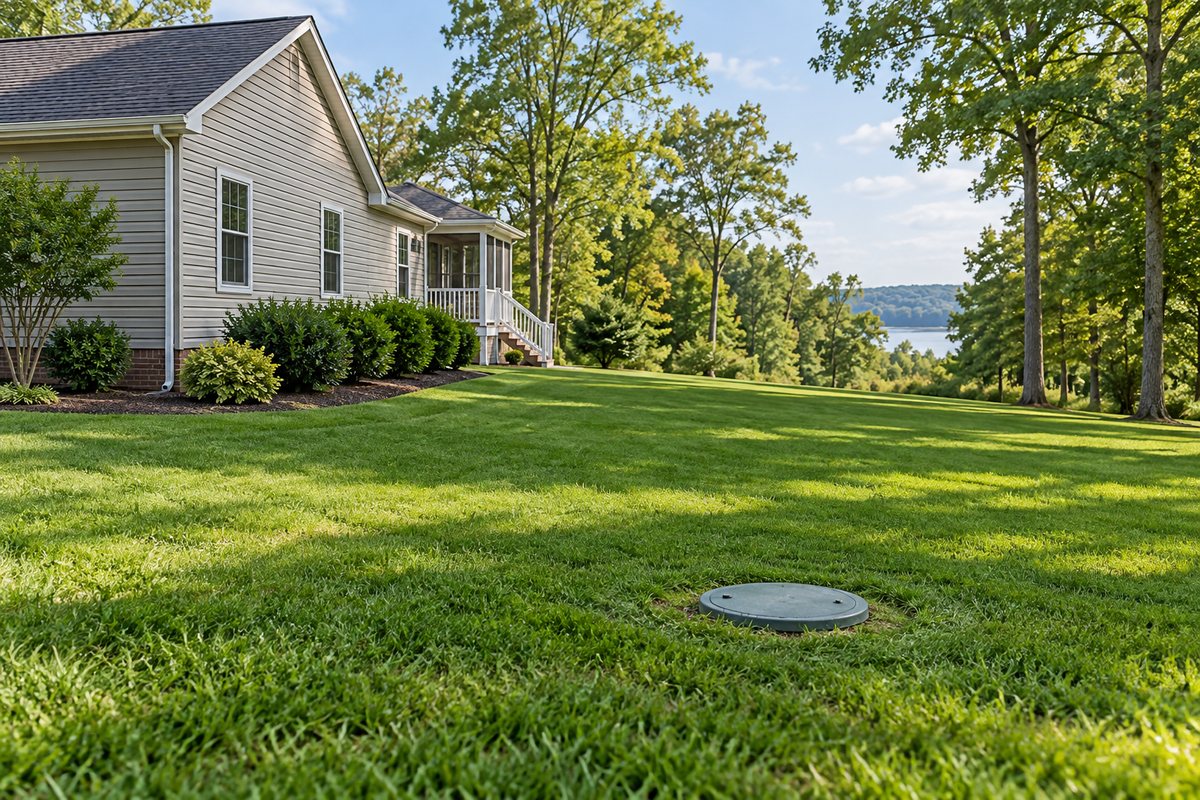

Replacing a septic system in St. Mary's County starts with the Health Department, and whether the new system must be a BAT nitrogen-removal system depends mostly on where the property sits. Inside the Critical Area, within 1,000 feet of tidal water, a replacement system must use BAT under COMAR 26.04.02.07. Outside it, BAT generally isn't required unless the soils call for it.
The good news is that Maryland's Bay Restoration Fund can pay for a large share of a BAT upgrade, and failing systems near the water get top priority. Below I walk through the permit steps, the grant, the ongoing maintenance a BAT system needs, and who to call. If you're selling, my well and septic selling guide covers what buyers will ask.
How Does a Septic Replacement Work in St. Mary's County?
It runs through the St. Mary's County Health Department's Environmental Health Division. Its septic page lays out the basic steps for new systems, expansions and repairs:
Septic Replacement Steps in St. Mary's County
From the St. Mary's County Health Department
- 1Complete perc testing when it's required for the repair.
- 2Have a Maryland-registered land surveyor prepare a surveyed site plan.
- 3File a septic construction application with the Environmental Health Division.
- 4Have the Health Department inspect the system before it's covered.
Call Environmental Health at 301-475-4321 or email smchd.env@maryland.gov before you hire anyone, so you know which steps apply to your property. If you're applying for a grant, that call matters even more, because of the timing rule below.
What Does a BAT System Do Differently?
It removes extra nitrogen before the wastewater reaches the ground. BAT stands for Best Available Technology, and Maryland's rules and the Bay Restoration Fund both describe it as technology "for nitrogen removal," per COMAR 26.04.02.07 and the state grant guidance.
Nitrogen from septic systems can reach groundwater and, eventually, the creeks and the Bay. That's why the rules are strictest in the Critical Area, where the land is closest to tidal water.
In practice, a BAT unit adds treatment equipment to a septic system. That's also why it needs electricity, an alarm and regular service, which a conventional tank doesn't.
Expect the surveyor, the contractor and the Health Department to each have their own schedule. Building in extra time is especially important if the system has already failed, so ask the Health Department about short-term options while the replacement moves through approval.
When Is a BAT System Required?
- Inside the Critical Area: new construction and replacement systems must use BAT under COMAR 26.04.02.07.
- Outside the Critical Area: since November 24, 2016, properties outside the 1,000-foot Critical Area are no longer required to install BAT, according to the St. Mary's County Health Department.
- The exception: the Health Department says BAT may still be required outside the Critical Area where soil conditions won't support a conventional system.
Not sure whether your property is in the Critical Area? My guide to the Critical Area and 100-foot Buffer explains the 1,000-foot line and who to ask.
How Much Does the Bay Restoration Fund Pay?
Often most or all of the BAT cost. Maryland's fiscal 2026 Bay Restoration Fund guidance says homeowners with household income at or below $300,000 a year can receive a grant for 100% of the eligible BAT cost, and 50% above that.
The St. Mary's County Health Department says the program covers the cost of the BAT, its installation, electrical hookup and two years of operation and maintenance. It doesn't cover permit or recordation fees, which the county lists at $53 to $200.
The county's page also mentions income limits based on the state's energy assistance program. In the state guidance, those limits apply to extra help for lower-income households, covered below. Confirm how your application will be evaluated with the Health Department.
| Bay Restoration Fund priority (state guidance) | Order |
|---|---|
| Failing systems in the Critical Area | 1 |
| Failing systems outside the Critical Area | 2 |
| Non-conforming systems in the Critical Area | 3 |
| Non-conforming systems outside the Critical Area | 4 |
| Other systems in the Critical Area / new construction | 5 |
| Other systems outside the Critical Area / new construction | 6 |
Source: MDE FY2026 Bay Restoration Fund program guidance, Section I.
When Do I Need to Apply for the Grant?
Before the BAT goes in. The Health Department says "grant funding must be approved prior to installation of the BAT." If you install first and apply later, you may not be able to get the grant at all.
That's the biggest money mistake on a septic replacement. Apply, get approved, then schedule the install with a certified contractor. The Health Department can give you a list of certified septic contractors who install approved systems.
Can I Connect to Public Sewer Instead?
Sometimes, if sewer service is available near the property. The St. Mary's County Health Department says the Bay Restoration Fund can also help with public sewer connections, up to $25,000 for a residence.
The state guidance lists sewer connections as eligible costs subject to MDE's prior approval and other conditions. Whether a connection is possible depends on where the nearest sewer line is, so ask the Health Department and the county about your specific address before choosing between a new system and a connection.
Is There Extra Help for Lower-Income Households?
Yes, in two ways, according to the state guidance. A low-income household with a failing system may get help with non-BAT parts, like a drainfield, if Bay Restoration Fund money remains after BAT grants. And low-income households may get a 50% grant for annual operation and maintenance after the initial period.
The guidance uses the state's energy assistance limits for fiscal 2026: a yearly gross income of $31,296 for a household of one and $42,300 for two, plus $10,859 for each additional person. These limits change each year, so check the current numbers when you apply.
What Maintenance Does a BAT System Need?
More than a regular septic tank. MDE's guidance on BAT requirements says BAT manufacturers must include a five-year operation and maintenance contract in the purchase price, and after that the owner "shall maintain a service contract with a certified provider for the life of the system."
That's the state's general rule. Your system's manufacturer and the county can add more specific maintenance steps, so keep the paperwork that came with your system.
- At least once a year, every BAT must be inspected and the needed maintenance performed.
- A certified service provider operates and maintains the system.
- An owner can get certified as a service provider to maintain their own system.
- After each visit, the provider notifies the local authority, MDE and the manufacturer, and keeps a service record.
Budget for that service contract as an ongoing cost of owning the home once the initial contract period ends. Lower-income households may qualify for the 50% maintenance grant described above, and the certified provider can quote the yearly cost for your specific unit.
Keep every service record. When you sell, buyers and inspectors will ask for them, and a gap in service is a common question.
What Is the Bay Restoration Fee?
It's a separate yearly fee, not the grant. MDE says homes on septic pay a Bay Restoration Fee of $60 a year per user of a septic system or holding tank, and the fee follows the owner of record. That fee helps fund the grants described above.
Paying the fee doesn't by itself make you eligible for a grant, and grants depend on current eligibility rules, funding and approval. Confirm with the Health Department before you schedule work you're counting on a grant to cover.
What If I'm Planning to Sell?
Replacing a system isn't automatically required to sell. But if your system is failing, a buyer's inspection will likely find it, and the replacement process takes time. MDE says that since July 1, 2022, anyone doing a property transfer septic inspection must be licensed.
If you're in the Critical Area, waterfront buyers know a future replacement means BAT, so they'll ask about age and condition. Having records, and a grant application if the system is failing, puts you in a much stronger position. My cost of selling guide shows where repairs and credits land on a net sheet.
What Records Should I Keep?
Septic and BAT Records to Keep
For your own upkeep and for a future sale
- The septic permit and as-built drawing
- The Health Department inspection record from installation
- Your Bay Restoration Fund grant approval, if you used one
- The BAT service contract and every yearly service report
- Pumping and repair receipts
What Does a Replacement Look Like Start to Finish?
Example scenario: This is a made-up example, not a real client.
Picture an owner of a home on a creek near Hollywood whose septic system starts backing up. Because the home is inside the Critical Area, the replacement must be BAT. The owner calls Environmental Health first, learns the steps, and applies for the Bay Restoration Fund grant.
Once the grant is approved, a certified contractor installs the system, the Health Department inspects it before it's covered, and the BAT comes with its first service contract. The owner files every document in one folder, which is exactly what the next buyer will ask to see.
What Mistakes Do Owners Make With Septic Replacements?
- Installing before the grant is approved. The Health Department says approval must come first.
- Letting the BAT service contract lapse. MDE requires a contract for the life of the system.
- Ignoring the alarm. It's the system telling you something needs service.
- Losing the paperwork. Buyers and inspectors will ask for it.
Who Should Answer Each Part?
- St. Mary's County Health Department, Environmental Health (301-475-4321): perc tests, permits, BAT requirements, grant applications and certified contractor lists.
- A Maryland-registered land surveyor: the surveyed site plan.
- A certified septic contractor: design, installation and quotes.
- A certified BAT service provider: the yearly inspection and maintenance.
- Your agent: timing a replacement around a sale and what buyers will ask.
The bottom line: call the Health Department first, apply for the Bay Restoration Fund before anything is installed, and keep a service contract and records for the life of a BAT system. If you're thinking about selling, see what to have ready and request a free home valuation.
Frequently Asked Questions
Maryland's fiscal 2026 guidance says homeowners with household income at or below $300,000 can receive a grant for 100% of the eligible BAT cost, and 50% above that. The St. Mary's County Health Department says it covers the BAT, installation, electrical hookup and two years of maintenance. See selling with a well and septic.
Yes. MDE says BAT manufacturers include a five-year operation and maintenance contract in the purchase price, and after that the owner must keep a service contract with a certified provider for the life of the system.
At least once a year, according to MDE's guidance on BAT requirements. A certified service provider does the inspection and maintenance and reports each visit to the local authority, MDE and the manufacturer.
Only if you're certified. MDE says a property owner may obtain certification as a service provider to maintain their own BAT system.
Yes. In MDE's fiscal 2026 guidance, failing systems in the Critical Area are first priority and failing systems outside it are second. My Critical Area guide explains the 1,000-foot line.
Contact the St. Mary's County Health Department's Environmental Health Division at 301-475-4321 or smchd.env@maryland.gov. Its steps include perc testing when required, a surveyed site plan, a septic construction application, and an inspection before the system is covered. If you are evaluating a vacant lot or need to understand what a perc test does, read my guide to perc tests and buildable lots.
Sources: St. Mary's County Health Department: On-site septic systems · St. Mary's County Health Department: Bay Restoration Fund · St. Mary's County Health Department: 2016 BAT rule change · COMAR 26.04.02.07 (BAT in the Critical Area) · MDE: FY2026 Bay Restoration Fund program guidance (updated July 9, 2025) · MDE: Q&A on BAT requirements and O&M · MDE: Onsite systems · MDE: Bay Restoration Fund FAQs. Checked October 2026; rules and rates can change, so confirm anything that affects your decision.
This article is general real estate information, not legal, lending, tax, or insurance advice. Talk with the right licensed professional about your specific property.
Selling a Home With an Older Septic System?
Nicole will help you figure out what buyers will ask and what to have ready, before you list.
Get My Free Home Valuation Schedule a Consultation