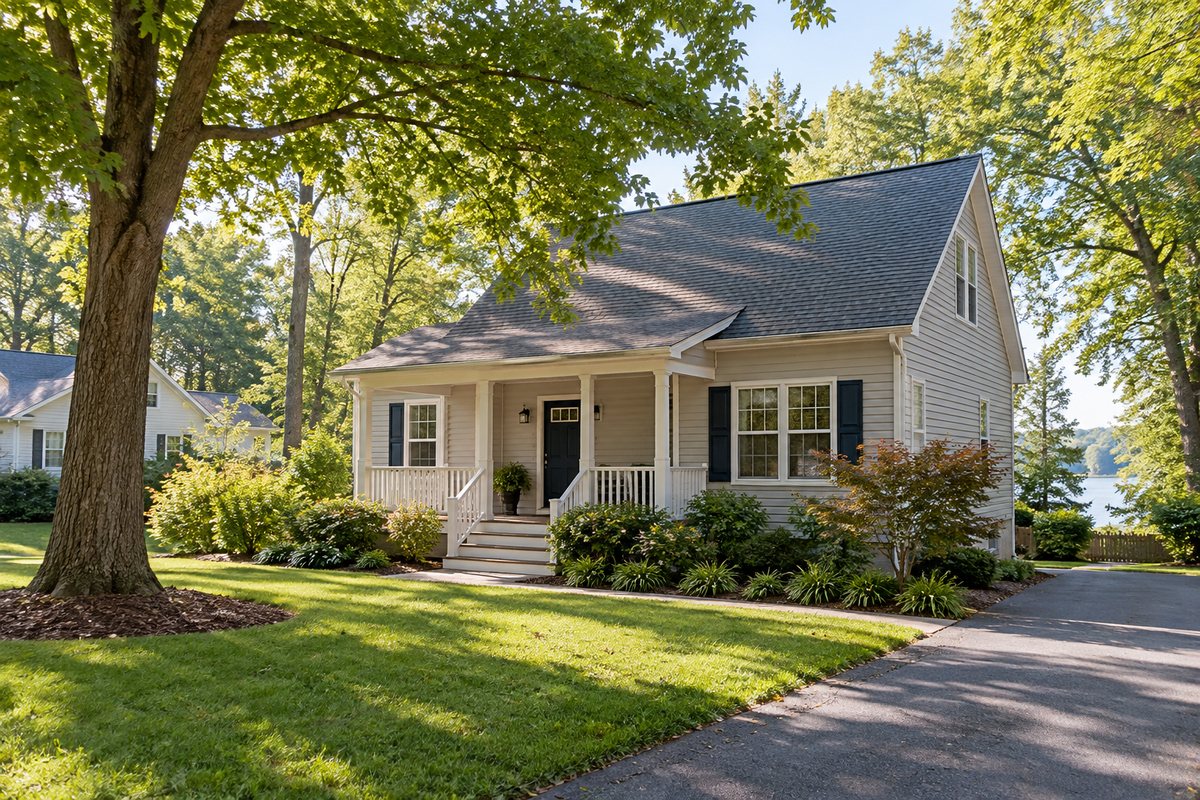

How much house can I afford in Maryland? It comes down to one ratio and one address. The ratio is your debt-to-income ratio, which every lender uses. The address matters because property taxes, insurance, and flood zones in St. Mary's County change your real monthly cost, and most online calculators don't know any of that.
Below, I'll walk you through how lenders size up your budget, what goes into a St. Mary's housing payment, and how to land on a number you'll actually be comfortable with. If you want the whole buying process start to finish, my first-time buyer guide covers it, and my guide to buying a home in St. Mary's County covers the county town by town.
How Much House Can I Afford in Maryland?
You can afford the home whose full monthly cost, plus your other debts, fits inside the debt-to-income limit your loan program allows, and still leaves you room to live. That's two tests, not one:
- The lender's test: your total monthly debts divided by your gross monthly income.
- Your test: whether that payment still works with groceries, gas, savings, and the first repair on a new-to-you house.
A preapproval tells you what a lender will lend. Your budget tells you what you can live with. You want both answers before you tour.
What Is a Debt-to-Income Ratio?
Your debt-to-income ratio (DTI) is "all your monthly debt payments divided by your gross monthly income," according to the Consumer Financial Protection Bureau. Gross means before taxes and deductions.
The CFPB's own example: $2,000 in monthly debt payments on $6,000 of gross monthly income is a 33% DTI. The CFPB also notes that different loan products and lenders have different DTI limits, which is why your loan type matters so much.
Debts usually include car payments, student loans, minimum credit card payments, and the new house payment itself. Your lender decides what counts, so bring your statements.
What DTI Do Lenders Allow?
It depends on the loan program, and the published limits are higher than most people expect. Here's what the program rules say:
These are general program guidelines, not approval limits. The standard that applies depends on the loan program, the underwriting method, the lender and your complete financial picture. A qualified lender confirms your actual options.
| Loan type | What the program guide says | Source |
|---|---|---|
| Conventional (Fannie Mae), manually underwritten | Maximum total DTI of 36%, up to 45% if the borrower meets credit score and reserve requirements | Fannie Mae Selling Guide B3-6-02 |
| Conventional (Fannie Mae), Desktop Underwriter | Maximum allowable DTI of 50% | Fannie Mae Selling Guide B3-6-02 |
| VA | The standard is 41% or less, and the VA also checks residual income | 38 CFR 36.4340 |
| FHA, USDA, Maryland Mortgage Program | Each has its own limits. Ask your lender which apply to you | Your lender |
DTI and residual income are two separate tests. The VA's standard DTI is 41% or less, and residual income is the money left each month after major expenses, which the VA compares against tables by family size and region under 38 CFR 36.4340. Meeting one test doesn't automatically mean you meet the other, and the lender makes the call.
The maximum isn't the goal. Plenty of buyers qualify near the top of their range and then feel squeezed every month. Taxes and insurance don't care what you were approved for.
How Does VA Residual Income Work in Maryland?
Residual income is the money left each month after your housing costs, debts, and taxes, and VA loans require you to have at least a set amount. Under federal VA rules (38 CFR 36.4340), Maryland is in the VA's South region.
For loans of $80,000 and above in the South region, the VA's minimum residual income table reads $441 for a household of one, $738 for two, $889 for three, $1,003 for four, and $1,039 for five, with $80 added for each additional member up to seven.
If you're buying on orders to NAS Patuxent River, your lender will run this for you. My PCS buyer checklist covers the rest of the VA side, including which Pax River gate you'll use.
What Goes Into a Monthly Housing Payment in St. Mary's County?
Your housing payment is more than principal and interest. Lenders count the whole package, often called PITI, plus a few local extras:
- Principal and interest on the loan.
- Property taxes: St. Mary's County's rate is $0.8478 per $100 of assessed value for fiscal 2026, per the Maryland Department of Legislative Services. The state adds $0.112 per $100, set by the Maryland Board of Public Works for fiscal 2026.
- Homeowners insurance, quoted for the specific house.
- Flood insurance if the home sits in a high-risk zone. In communities in the National Flood Insurance Program, FEMA says flood insurance is mandatory for federally backed mortgages in high-risk zones A and V.
- HOA or condo fees, if the community has them.
- Mortgage insurance, depending on your loan type and down payment.
Here's the tax piece with real numbers. On a home assessed at $350,000, the county tax is about $2,967 a year and the state tax is about $392, for roughly $3,359 a year, or about $280 a month. I break down the Homestead Credit and assessments in my St. Mary's property tax guide.
How Do I Figure Out My Number, Step by Step?
Work from your income down to a price, not from a listing up to a payment. Here's the order I'd go in:
- Add up your gross monthly income. Use what a lender can document, like W-2 pay, military pay statements, or two years of self-employment returns.
- List your monthly debts. Use minimum payments from your statements, not what you usually pay.
- Pick a DTI you're comfortable with, not just the maximum. Run it at a couple of levels so you can see the difference.
- Subtract your debts from that DTI amount. What's left is your ceiling for the full housing payment.
- Take out taxes, insurance, flood, and HOA for the area you're shopping. That's why the address matters.
- Let your lender turn the rest into a loan amount at today's rate and your loan type, then get preapproved.
- Check your cash. You'll need money for closing costs, inspections, and a cushion after you move in, not just the down payment. If you need to sell your current home first, here's how I help St. Mary's sellers.
How Much House Can I Afford in Maryland?
Figure out your number in 7 steps
- 1Add up your gross monthly income.
- 2List your monthly debts.
- 3Pick a DTI you're comfortable with.
- 4Subtract your debts.
- 5Take out taxes, insurance, flood, and HOA.
- 6Let your lender turn the rest into a loan amount.
- 7Check your cash.
The calculator doesn't know your address. Your lender and I do, so bring us the town or even the street you're looking at.
What Does That Look Like With Real Numbers?
Example scenario: This is a made-up example to show the math, not a real buyer and not a loan offer.
Picture a buyer shopping in Lexington Park with $7,500 a month in gross income and $450 a month in car and student loan payments.
Every number in this example, from income and debts to the rate, taxes, insurance, HOA and down payment, is an assumption. Only a lender's preapproval tells you what you can actually borrow.
| DTI level | Total debt allowed | Minus other debts | Left for the full housing payment |
|---|---|---|---|
| 36% | $2,700 | $450 | $2,250 |
| 41% | $3,075 | $450 | $2,625 |
| 45% | $3,375 | $450 | $2,925 |
That last column has to cover everything: principal, interest, taxes, insurance, and any HOA or flood insurance. If the home is assessed at $350,000, about $280 of it goes to county and state property taxes before insurance. The spread between 36% and 45% is $675 a month, which is why picking your own comfort level matters as much as the lender's limit.
What St. Mary's Costs Do Online Calculators Miss?
Most national calculators use one statewide tax guess and skip the local details. In St. Mary's, I'd add these to your budget before you fall for a house:
- The state property tax. The $0.112 state rate sits on top of the county rate, and some estimates leave it out.
- Flood zones near the water. Look up any address on the FEMA Flood Map Service Center before you offer. My waterfront buyer's guide covers what else to check on the water.
- Well and septic. Many homes here aren't on public water and sewer. Budget for the well test and septic inspection during your inspection period, and ask about the system's age.
- New construction taxes. A new home's first tax estimate may be based on the lot, not the finished house. Ask how the builder and lender estimated it, and compare in new construction vs. resale.
- Closing costs and transfer taxes. St. Mary's County's transfer tax is 1.0%, per the Department of Legislative Services, and the first $30,000 is exempt when the buyer will live in the home, according to the Capitol Title Maryland transfer and recordation chart. on top of state transfer and recordation taxes. The St. Mary's section of my buyer guide explains how they're usually split.
Can a Maryland Program Help Me Afford More?
It can help with cash to close, and it's worth asking about before you set your price range. The Maryland Mortgage Program (MMP) publishes limits for each county. For St. Mary's County, effective June 24, 2026, the income limit is $141,600 for a household of one or two and $162,840 for three or more, with a maximum acquisition cost of $566,354.
Only an MMP-approved lender can tell you which product fits and whether you qualify. Ask about it at your first lender call.
Who Should Answer Each Part of the Budget?
No single person has every number, so here's who to ask:
- Your lender: DTI limits, residual income, your rate, loan amount, mortgage insurance, and program eligibility.
- An insurance agent: homeowners and flood insurance quotes on the specific address.
- SDAT and the county: a home's current assessment and tax history, which you can look up on SDAT's real property search.
- The settlement company: your estimated closing costs and transfer and recordation taxes.
- Me: what homes in your range look like, which areas fit your commute, and the local items like well, septic, flood zone, and HOA on each home we look at.
What Mistakes Should I Avoid?
- Shopping by list price. Two homes at the same price can have very different taxes, insurance, and HOA fees.
- Treating your approval as your budget. The approval is the ceiling, not the target.
- Forgetting cash to close. Closing costs, inspections, and moving costs all come before your first payment.
- Opening new credit before closing. A new car or card changes your DTI, and your lender will check again.
- Skipping the flood zone check. Near the water, flood insurance can move your monthly number a lot.
The Bottom Line
How much house you can afford in Maryland is your income, minus your debts, minus the real local costs of the specific home. Get the DTI from your lender, get the taxes, insurance, and flood zone for the address, and choose a payment you'd still be happy with on a tight month. When you're ready to look, tell me what you're shopping for and I'll check the local numbers on every home I send.
Frequently Asked Questions
Start with your gross monthly income, multiply it by the debt-to-income ratio your loan program allows, and subtract your other monthly debts. What's left has to cover principal, interest, taxes, insurance, and any HOA or flood insurance. Your lender turns that into a loan amount, and I can help you check the local costs on each home.
It depends on the loan. Fannie Mae's Selling Guide allows up to 36% total DTI on manually underwritten loans, up to 45% with qualifying credit and reserves, and up to 50% through Desktop Underwriter. VA's standard is 41% or less, plus a residual income check. Your lender will tell you which limits apply to you.
Maryland is in the VA's South region. For loans of $80,000 and above, the VA's minimum residual income is $441 for one person, $738 for two, $889 for three, $1,003 for four, and $1,039 for five, under 38 CFR 36.4340. Your VA lender calculates it for you.
Plan for property taxes (the county rate is $0.8478 per $100 of assessed value for fiscal 2026, and the state adds $0.112), homeowners insurance, flood insurance if the home is in a high-risk zone, any HOA dues, and upkeep on a well and septic system if the home has them. My property tax guide shows how to estimate the tax bill.
Only if the home is in a high-risk flood zone and your loan requires it. FEMA says flood insurance is mandatory for federally backed mortgages in high-risk zones A and V in participating communities. Check any address on the FEMA Flood Map Service Center and get a quote before you offer.
Your preapproval is the most a lender will lend, not a target. Run your budget at a couple of DTI levels and pick a payment that still works on a tight month. That leaves room for repairs, savings, and the costs that come with owning.
Sources: CFPB: What is a debt-to-income ratio? · Fannie Mae Selling Guide B3-6-02 · 38 CFR 36.4340 (VA underwriting standards) · Maryland DLS 2026 county tax rates · Maryland Board of Public Works FY2026 state tax rate · FEMA FloodSmart: What is my flood zone? · Maryland Mortgage Program limits (effective June 24, 2026). Checked October 2026; rules and rates can change, so confirm anything that affects your decision.
This article is general real estate information, not legal, lending, tax, or insurance advice. Talk with the right licensed professional about your specific property.
Thinking About Buying in St. Mary's?
Tell Nicole what you're looking for and she'll send matching homes, with the local details checked.
Tell Me What You're Looking For Schedule a Consultation